Blog
Greek PDO and PGI Olive Oil products (list, specifications and info)


Info and facts about PDO and PGI Olive Oil products – Greek PDO and PGI Olive Oil products
PDO – PGI – TSG olive oil PRODUCTS
Beskermde Oorsprongsbenaming – (PDO)
Protected Geographical Indication – (PGI)
Traditional Specialities Guaranteed – (TSG)
What is a PDO – PGI – TSG olive oil product;
The European Commission has defined “PDO” and “PGI” designate agricultural products that are linked to specific parts of Europe, these designations are meant to help avoid confusion over inappropriate claims about agriculture products origins.
– “PDO” stands for Protected Designation of Origin (Italian: Denominazione di Origine Protetta, or DOP)
– “PGI” stands for Protected Geographical Indication
In 1992 according to the regulation 2081/92, the European Union first adopted the system for the protection of geographical indications and the designations of origin of agricultural products and foodstuffs and according to the regulation 2082/92 the rules on the certificates of specific character for agricultural products and foodstuffs. In 2006 to improve the system, the above regulations have been replaced by regulations (EC) 510/06 and (EC) 509/06 respectively, without changing their scope and feasibility.
By Regulation (EE)1151/2012 of 21 November 2012 on quality schemes for agricultural products and foodstuffs the above mentioned regulations ((EC)509/2006 and (EC)510/2006) are merged into a single legal framework. While in this regulation have been added and other quality schemes such as optional quality terms “mountain product”, “product of island farming” etc.
In accordance with the aforementioned regulations and under the reorientation of the Common Agricultural Policy (CAP), the farmers are encouraged to switch to forms of integrated rural development through the diversification of rural production. Furthermore, it is possible the producers (especially in disadvantaged and remote areas) to promote easily their products with special characteristics, achieving better market prices and thereby improving their income and on the other hand consumers to buy quality products with guarantees for the production, processing and geographic origin.
Definitions
Designation of Origin
‘Designation of Origin’ is a name which identifies a product:
(a) originating in a specific place, region or, in exceptional cases, a country;
(b) whose quality or characteristics are essentially or exclusively due to a particular geographical environment with its inherent natural and human factors; and
(c) the production steps of which all take place in the defined geographical area.
Geographical Indication
‘Geographical Indication’ is a name which identifies a product:
(a) originating in a specific place, region or country;
(b) whose given quality, reputation or other characteristic is essentially attributable to its geographical origin; and
(c) at least one of the production steps of which take place in the defined geographical area
Traditional Speciality Guaranteed Product
A name shall be eligible for registration as a ‘traditional specialty guaranteed’ where it describes a specific product or foodstuff that:
(a) results from a mode of production, processing or composition corresponding to traditional practice for that product or foodstuff; or
(b) is produced from raw materials or ingredients that are those traditionally used.
PDO and PGI olive oil products – what is the difference?
The differences between PDO and PGI olive oils are linked primarily to how much of the olive oils’ raw materials must come from the area, or how much of the olive oils’ production process has to take place within the specific region.
Both, PDO and PGI certifications, serve to guarantee certain qualities of the product and one relationship between these qualities and the place where the product has been made.
PDO and PGI labels are used to protect agri-food products, being used as a quality indicator – PDO and PGI products represent the excellence of European agricultural food production, and are both the result of a unique combination of human and environmental factors that are characteristic of a specific territory.
PDO and PGI olive oil certification standards and labeling offers consumers the guarantee that typical, authentic and quality products are being bought, which are part of the food heritage of specific areas of the European Union Countries.
Protected Designation of Origin (PDO) olive oils
With the acronym PDO, olive oil products with a specific provenance are identified, either from a specific place, from a region or exceptionally from a country.
However, it is not enough that its origin is geographically delimited, but that the features of the olive oil’s product must be exclusively or fundamentally due to that particular place and also, all the olive’s oil production phases must have been carried out in that defined geographical area.
Protected Geographical Indication (PGI) olive oils
The acronym PGI also delimits the geographical area of the olive oil’s products as well as the Designation of Origin does, but the main difference is that in the PGI Olive Oil it is not necessary that all the olive oil’s production phases are carried out in the geographical place. It is only necessary that at least one of the phases is done in that area.
– – –
A Protected Designation of Origin (PDO) olive oil has a greater connection with the delimited area as the whole olive oil production process takes place in that area exclusively – a Protected Geographical Indication (PGI) olive oil product keeps some quality or reputation of that place of origin, but the whole process of production does not necessarily need to be done in that area exclusively.
In the case of a Protected Designation of Origin (PDO) olive oil, all of the olive’s oil production phases, farming AND processing AND preparation, all take place in that area only.
Competent Authorities for official controls
In Greece, since 1.6.2006, EL.G.O. DEMETER (former AGROCERT), has been authorized to grant certification to enterprises, to carry out controls in cooperation with the Directorates of the Rural Development of the Prefectures, to ensure compliance with the specifications, to certify the products in question as well as to keep a register of the enterprises approved for the usage of PDO and PGI indications.
(BRON: HELLENIC REPUBLIC – Ministry of Rural Development and Food > PDO – PGI – TSG Products)
List and specifications of Greek PDO and PGI Olive Oil products
There are 30 EU registered PDO olive oils and PGI olive oils for Greece
|
OLIVE OILS
|
|||
| PRODUCT | PGI/PDO | REGISTERED NAME | SPECIFICATIONS |
| Άγιος Ματθαίος Κέρκυρας | P.G.I. | Agios Mattheos Kerkyras | C321 / 2003 pg. 43 |
| Αποκορώνας Χανίων Κρήτης | P.D.O. | Apokoronas Chanion Kritis (Crete) | 440338 / 18-11-1993, (O.J no. 878/6-12-93) |
| Αρχάνες Ηρακλείου Κρήτης | P.D.O. | Arxanes Irakliou Kritis (Crete) | 371575 / 19-07-1993,(O.J no. 575/2-08-93) |
| Βιάννος Ηρακλείου Κρήτης | P.D.O. | Viannos Irakliou Kritis (Crete) | 379576 / 23-08-1993 , (O.J no. 677/2-09-93) |
| Βόρειος Μυλοπόταμος Ρεθύμνης Κρήτης | P.D.O. | Vorios Mylopotamos Rethymnis Kritis (Crete) | O. J. L 148/21.06.1996, O. J. L 129/14.05.2013, C 183/23.06.2012 |
| Εξαιρετικό παρθένο ελαιόλαδο “Τροιζηνία” | P.D.O. | Exeretiko partheno eleolado “Trizinia” | C128 / 2006 pg. 11 |
| Εξαιρετικό παρθένο ελαιόλαδο Θραψανό | P.D.O. | Exeretiko partheno eleolado Thrapsano (Crete) | C241 / 2001 pg. 12 |
| Εξαιρετικό παρθένο ελαιόλαδο Σέλινο Κρήτης | P.D.O. | Exeretiko Partheno Eleolado Selino Kritis (Crete) | C232 / 2009 pg. 27 ,(L118/2010 pg.8) |
| Ζάκυνθος | P.G.I. | Zakynthos | 379565 / 20-08-1993, (O.J no. 669/2-09-93) |
| Θάσος | P.G.I. | Thassos | 440305 / 11-11-1993, (O.J no. 871/26-11-93) |
| Κεφαλονιά | P.G.I. | Kefalonia | 315782 / 14-01-1994 , (O.J no. 15/14-01-94) |
| Κολυμβάρι Χανίων Κρήτης | P.D.O. | Kolymvari Chanion Kritis (Crete) | 371571 / 19-07-1993, (O.J no. 574/2-08-93) |
| Κρανίδι Αργολίδας | P.D.O. | Kranidi Argolidas | 315790 / 14-01-1994, (O.J no. 15/14-01-94) |
| Κροκεές Λακωνίας | P.D.O. | Krokees Lakonias | 317738 / 18-01-1994 , (O.J no.24/18-01-94) |
| Ολυμπία | P.G.I. | Olympia | 392926 / 31-08-1993, (O.J no. 745/27-09-93) |
| Χανιά Κρήτης | P.G.I. | Chania Kritis (Crete) | 379563 / 20-08-1993, (O.J no. 821/7-10-93) |
| Λακωνία | P.G.I. | Lakonia | 444282 / 23-12-1993, (O.J no.955/31-12-93) |
| Λέσβος ; Mυτιλήνη | P.G.I. | Lesvos (Mytilini) | 371579 / 19-07-1993, (O.J no. 575/2-08-93) |
| Λυγουριό Ασκληπιείου | P.D.O. | Lygourio Asklipiiou | 440327 / 15-11-1993, (O.J no. 871/26-11-93) |
| Πεζά Ηρακλείου Κρήτης | P.D.O. | Peza Irakliou Kritis (Crete) | 371573 / 19-07-1993, (O.J no. 574/2-08-93) |
| Πέτρινα Λακωνίας | P.D.O. | Petrina Lakonias | 317714 / 14-01-1994, (O.J no. 17/14-01-94) |
| Πρέβεζα | P.G.I. | Preveza | 440329 / 15-11-1993, (O.J no.871/26-11-93) |
| Φοινικι Λακωνιασ | P.D.O. | Finiki Lakonias | C180 / 2001 pg. 10 |
| Ρόδος | P.G.I. | Rodos | 315783 /14-01-1994, (O.J no. 15/14-01-94) |
| Σάμος | P.G.I. | Samos | 371572 / 19-07-1993, (O.J no. 574/2-08-93) |
| Καλαμάτα | P.D.O. | Kalamata | 379567 / 20-08-1993, (O.J no. 821/7-10-93) |
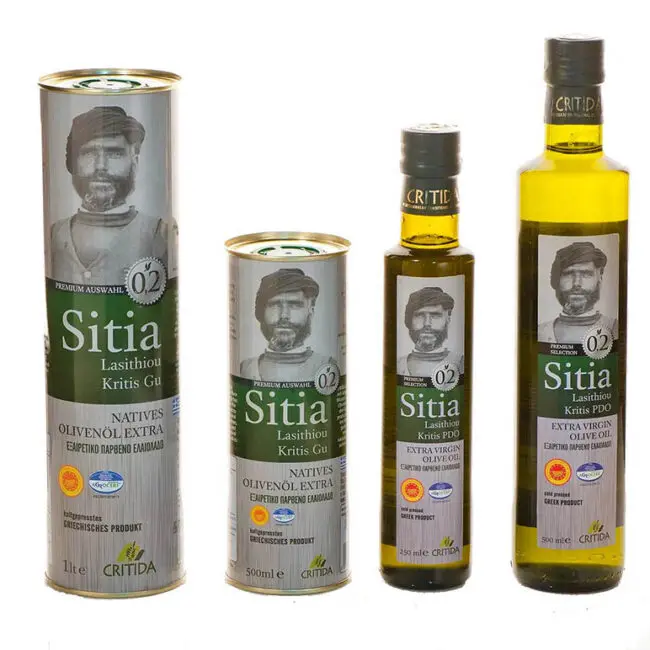
| Σητεία Λασιθίου Κρήτης | P.D.O. | Sitia Lasithiou Kritis (Crete) | 440339 / 18-11-1993, (O.J no. 878/6-12-93) |
| Αγουρέλαιο Χαλκιδικής | P.D.O. | Agoureleo Chalkidikis | O.J L169/21.06.2013, C294/29.09.2012 |
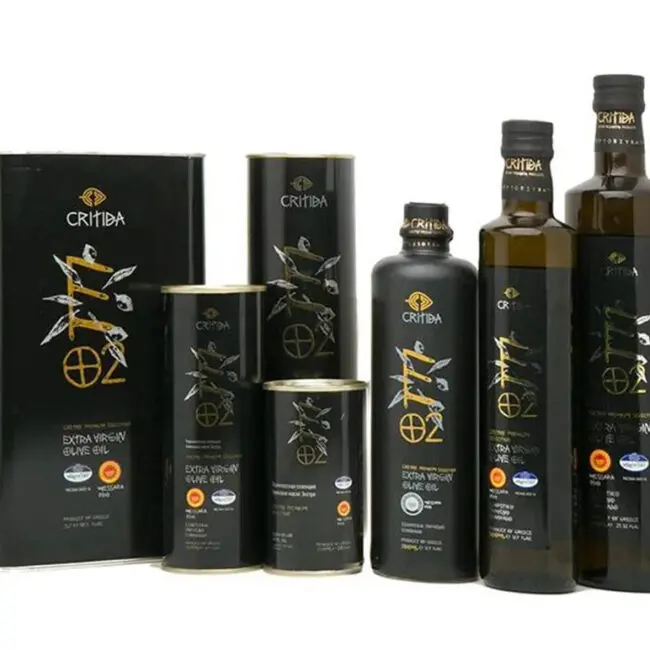
| Μεσσαρά | P.D.O. | Messara (Crete) | O.J L272/12.10.2013, C294/29.09.2012 |
| OLIVES | |||
| Ελιά Καλαμάτας | P.D.O. | Elia Kalamatas | 440304 / 11-11-1993, (O.J no. 871/26-11-93) |
| Θρούμπα Αμπαδιάς Ρεθύμνης Κρήτης | P.D.O. | Throumpa Ampadias Rethymnis Kritis | 444281 / 23-12-1993, (O.J no. 955/31-12-93) |
| Θρούμπα Θάσου | P.D.O. | Throumpa Thassou | 315781 / 14-01-1994 (O.J no. 15/14-01-94), 290826/18-08-2010 (O.J no. 1368/02-09-2010) |
| Θρούμπα Χίου | P.D.O. | Throumpa Chiou | 315800 / 14-01-1994 (O.J no. 15/14-01-94) |
| Κονσερβολιά Αμφίσσης | P.D.O. | Konservolia Amfissis | 317746 / 18-01-1994 (O.J no. 24/18-01-94) |
| Κονσερβολιά Άρτας | P.G.I. | Konservolia Artas | 317713 / 14-01-1994 (O.J no. 17/14-01-94) |
| Κονσερβολιά Αταλάντης | P.D.O. | Konservolia Atalantis | 317740 / 18-01-1994 (O.J no. 24/18-01-94) |
| Κονσερβολιά Πηλίου Βόλου | P.D.O. | Konservolia Piliou Volou | 317712/14-01-1994 (O.J no. 17/14-01-94) |
| Κονσερβολιά Ροβίων | P.D.O. | Konservolia Rovion | O.J. L10/15.01.2014, O.J C 228/07.08.2013,O.J L 163/02.07.1996 |
| Κονσερβολιά Στυλίδας | P.D.O. | Konservolia Stylidas | O.J. L299/09.11.2013 Ο.J. L163/02.07.1996 |
| Πράσινες Ελιές Χαλκιδικής | P.D.O. | Prasines Elies Chalkidikis | C19/24-01-2012 pg.11 L132/23-05-2012 pg.1 |
Griekeland spog met die grootste persentasie olyfboombedekking per landoppervlakte in die wêreld.
Find more information regarding PDO en PGI agricultural products at the EU online database (eAmbrosia):
eAmbrosia – the EU geographical indications register

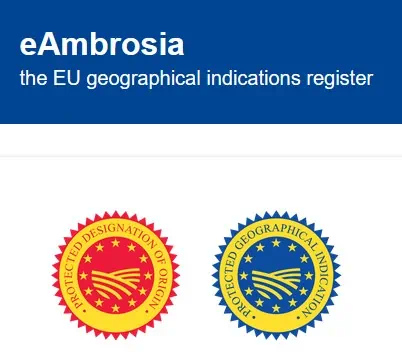
eAmbrosia is a legal register of the names of agricultural products and foodstuffs, wine, and spirit drinks that are registered and protected across the EU (European Union).
It provides a direct access to information on all registered geographical indications, including the legal instruments of protection and product specifications. It also displays key dates and links for applications and publications before the geographical indications are registered.
Geographical Indications and quality schemes in European Union
Aims of EU quality schemes
EU quality policy aims to protect the names of specific products to promote their unique characteristics, linked to their geographical origin as well as traditional know-how.
Product names can be granted a ‘geographical indication’ (GI) if they have a specific link to the place where they are made. The GI recognition enables consumers to trust and distinguish quality products while also helping producers to market their products better.
Products that are under consideration or have been granted GI recognition are listed in geographical indications registers. The registers also include information on the geographical and production specifications for each product.
Recognised as intellectual property, geographical indications play an increasingly important role in trade negotiations between the EU and other countries.
Other EU quality schemes emphasise the traditional production process or products made in difficult natural areas such as mountains or islands
Geographical Indications
Geographical indications establish intellectual property rights for specific products, whose qualities are specifically linked to the area of production.
Geographical indications comprise:
PDO – protected designation of origin (food and wine)
PGI – protected geographical indication (food and wine)
GI – geographical indication (spirit drinks).
The EU geographical indications system protects the names of products that originate from specific regions and have specific qualities or enjoy a reputation linked to the production territory. The differences between PDO and PGI are linked primarily to how much of the product’s raw materials must come from the area, or how much of the production process has to take place within the specific region. GI is specific for spirit drinks.
Beskermde Oorsprongsbenaming (BOB)
Product names registered as PDO are those that have the strongest links to the place in which they are made.
Produkte: food, agricultural products and wines.
Specifications: Every part of the production, processing and preparation process must take place in the specific region. For wines, this means that the grapes have to come exclusively from the geographical area where the wine is made.
Example: Kalamata olive oil PDO is entirely produced in the region of Kalamata in Greece, using olive varieties from that area.
Label: mandatory for food and agricultural products, optional for wine.
Protected Geographical Indication (PGI)
PGI emphasises the relationship between the specific geographic region and the name of the product, where a particular quality, reputation or other characteristic is essentially attributable to its geographical origin.
Produkte: food, agricultural products and wines.
Specifications: For most products, at least one of the stages of production, processing or preparation takes place in the region. In the case of wine, this means that at least 85% of the grapes used have to come exclusively from the geographical area where the wine is actually made.
Example: Westfälischer Knochenschinken PGI ham is produced in Westphalia using age-old techniques, but the meat used does not exclusively come from animals born and reared in that specific region of Germany.
Label: mandatory for food, agricultural products, optional for wines.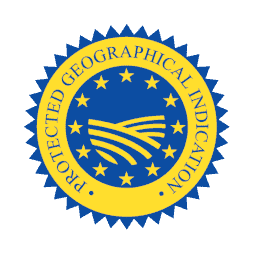
PDO & PGI olive oils from Crete
Crete is leading the olive oil production in Greece and is the region with the highest consumption of olive oil too. About 35 million olive trees are planted on the island of Crete (covering a 65% of all agricultural area of the island). The majority of the olive oil produced in Crete is extra virgin olive oil (EVOO) extracted from the “Koroneiki” and “Tsounati” olive varieties (Koroneiki olive variety dominates, as it does on mainland Greece, but there are some other local olive varieties on Crete too such as Tsounati (predominantly in Chania area), Throumbalia olive variety (predominantly in Rethymnon) and Hondrolia variety (in Heraklion). Olive oil is the basis of the famous Kretaanse Dieet and is famous worldwide for its incredible flavor and antioxidant properties that boost human health. There are about 11 types of olive oil in Crete today recognized and protected as PDO or PGI products by the European Union.
Crete leads the islands in the international market. The island of Crete boasts seven PDO olive oil regions as well as one PGI olive oil region, protected by European Union certifications.
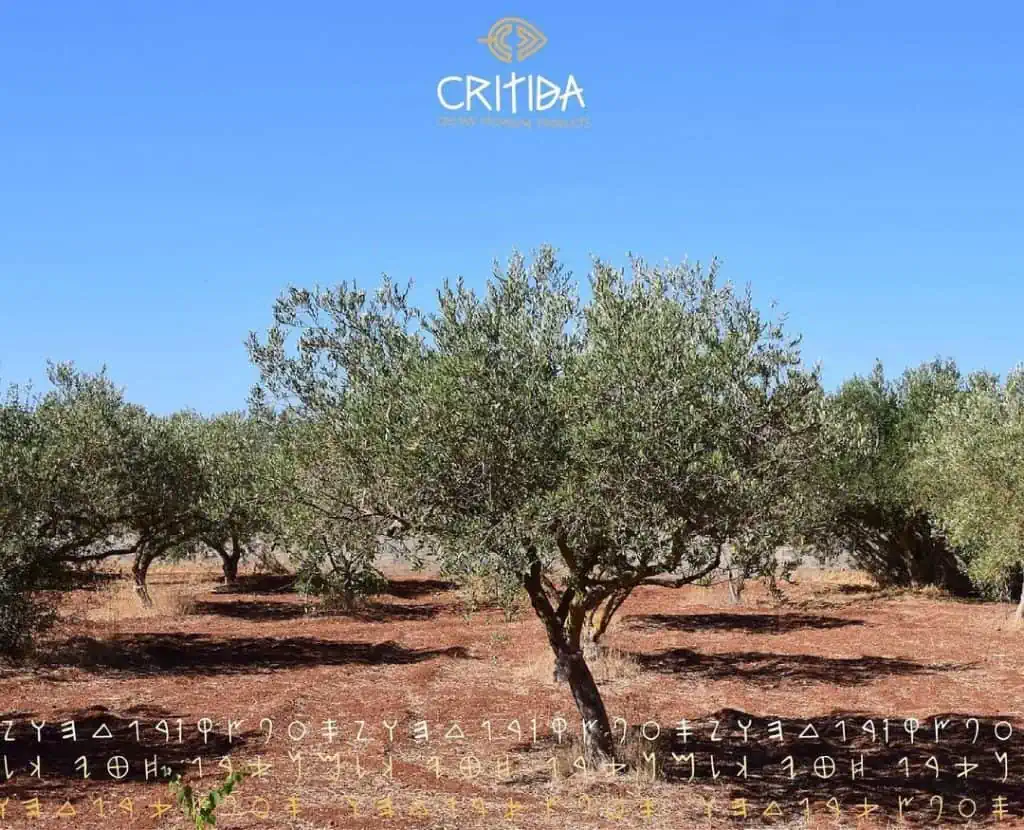
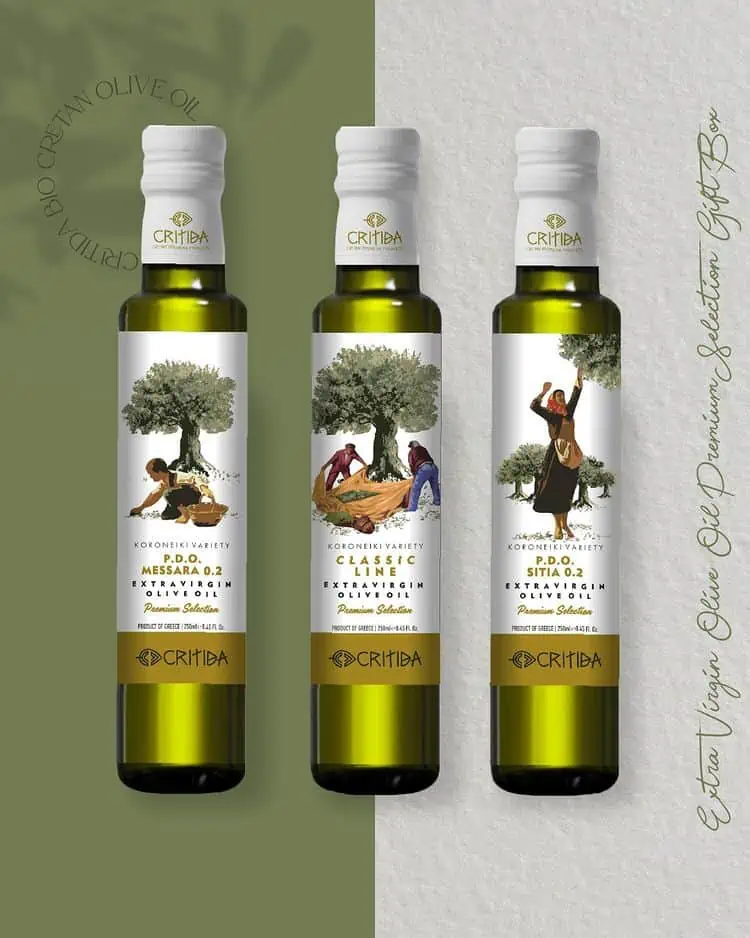
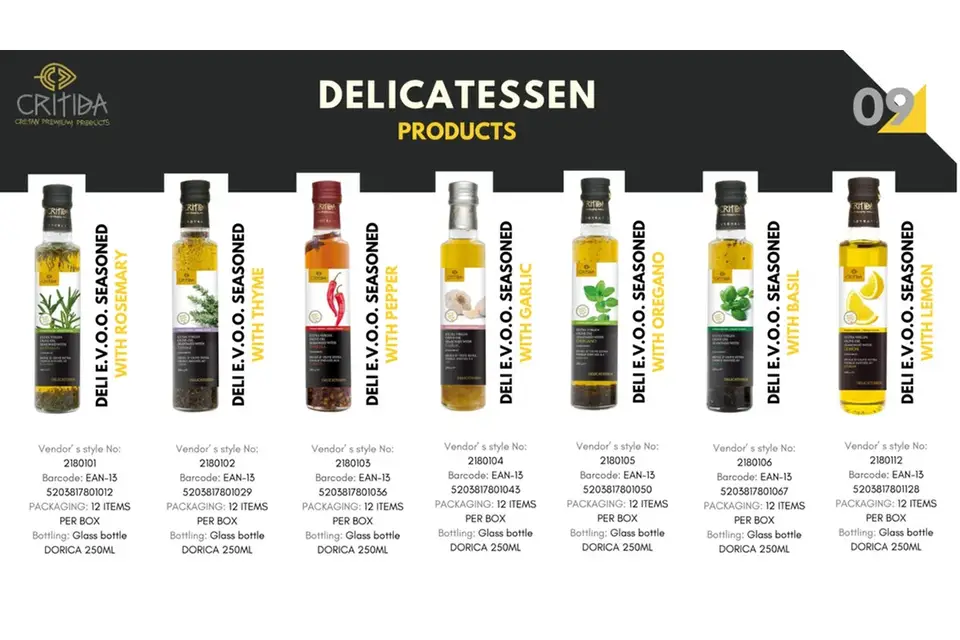
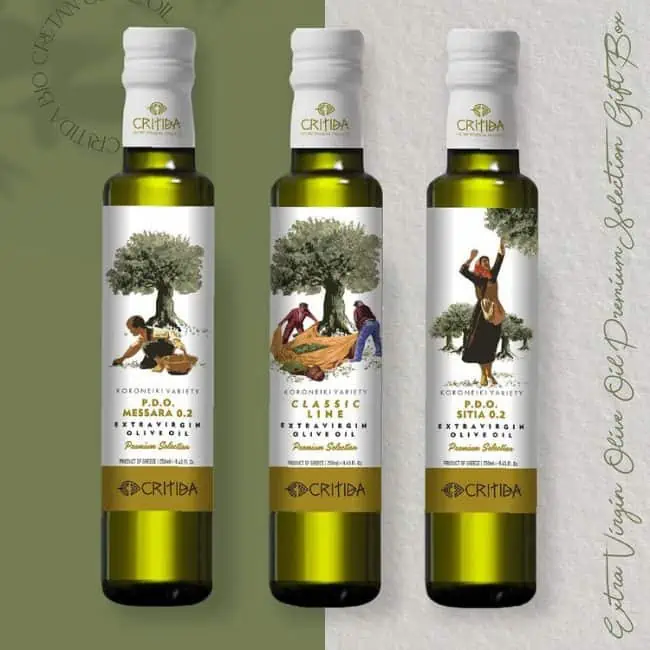
CRITIDA Bio Cretan Olive Oil:
our premium PDO & PGI EVOO (Extra Virgin Olive Oil) olive oil products from the island of Crete in Greece